
2026. november 23., hétfő
Kelemen névnapja
Kelemen névnapja
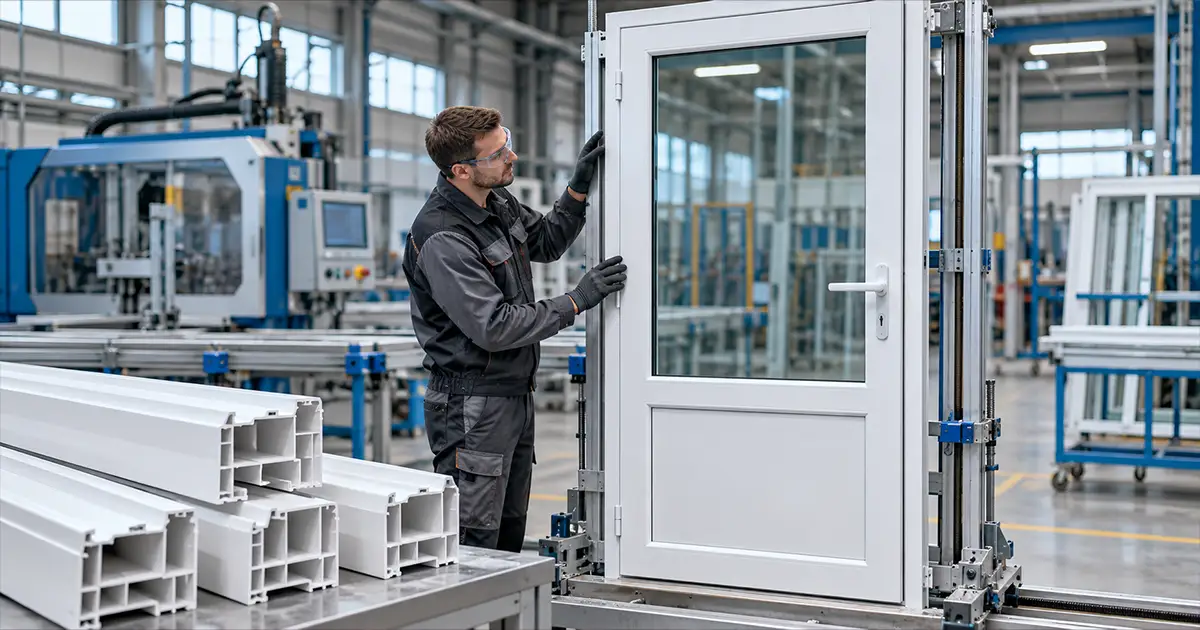
A finished uPVC door may look like a relatively simple product, but manufacturing one involves a carefully controlled sequence of cutting, reinforcement, welding, glazing, and hardware installation. Each stage affects how the door fits, operates, and performs after installation.
For overseas importers, building contractors, and door distributors, understanding this process provides valuable insight into product quality. Two doors made from similar-looking profiles may perform differently because of variations in fabrication accuracy, internal reinforcement, welding quality, and component selection.
A UPVC door factory manufactures doors by converting extruded PVC profiles into accurately sized frames and sashes, adding structural reinforcement, welding or mechanically joining the profiles, installing glazing or infill panels, fitting hardware, and inspecting the completed assemblies.
Although individual factories use different equipment and production methods, the fundamental manufacturing principles are broadly similar.
Understanding the Raw Profiles Used in UPVC Door Manufacturing
The manufacturing process begins with uPVC profiles, which form the main structural components of the door.
UPVC stands for unplasticized polyvinyl chloride, a rigid polymer commonly used in building products.
Door profiles are typically produced through extrusion. During this process, a prepared PVC compound is heated and pushed through a specially designed die to create a continuous profile with a consistent cross-sectional shape.
The profile is then cooled, calibrated, and cut into transportable lengths.
Many door manufacturers purchase finished profiles from specialized extrusion suppliers, while vertically integrated operations may produce their own.
Different profiles serve different purposes, including outer frames, opening sashes, mullions, glazing beads, and threshold connections.
Their internal chambers, wall thicknesses, and reinforcement cavities are determined by the profile system.
Before fabrication begins, the factory must ensure that the selected profiles are suitable for the intended door dimensions and application.
Step 1: Reviewing Drawings and Preparing Production Dimensions
A UPVC door factory normally starts fabrication with an approved production specification.
This document identifies the door width, height, opening direction, profile system, glazing arrangement, and hardware requirements.
For custom uPVC doors, manufacturing dimensions must account for more than the nominal opening size.
The factory also considers frame joints, sash clearances, glazing allowances, and hardware positioning.
Cutting lists are prepared for each component.
Computer-aided manufacturing software may help calculate dimensions and organize material usage, particularly for projects involving multiple door sizes.
Errors at this stage can affect every subsequent operation.
A sash cut to the wrong dimensions cannot necessarily be corrected through hardware adjustment.
For this reason, accurate production drawings and clear revision control are essential before materials enter the cutting process.
Step 2: Cutting the UPVC Profiles
Once the cutting lists are approved, the raw profiles are transferred to the cutting station.
Specialized saws cut the profiles to their required lengths and angles.
For welded frame corners, 45-degree cuts are commonly used to form miter joints.
Other components may require square cuts or different machining arrangements depending on the system.
Cutting accuracy is important because small dimensional differences can accumulate across the completed frame.
Poorly cut profiles may create uneven joints, inaccurate sash dimensions, or difficulties during welding.
Factories may use single-head or double-head cutting saws, with more automated systems helping improve repeatability.
Operators also inspect cut surfaces for defects, contamination, and irregular edges.
The goal is to prepare components that can be assembled consistently without excessive correction later.
Step 3: Installing Structural Reinforcement
Unlike aluminum profiles, which provide structural strength through their metal sections, uPVC door frames often rely on internal reinforcement to meet particular loading requirements.
Many systems incorporate galvanized steel reinforcement inside designated profile chambers.
The reinforcement is cut to the required length and secured using appropriate mechanical fasteners.
Its shape, thickness, and placement depend on the profile design and the manufacturer's engineering requirements.
Reinforcement is particularly important for larger door leaves, heavily glazed assemblies, and locations exposed to significant wind loads.
However, not every uPVC profile uses identical reinforcement arrangements.
Some systems incorporate alternative reinforcement technologies or specialized composite components.
A professional UPVC door factory should follow the technical specifications of the selected profile system rather than treating reinforcement as an interchangeable accessory.
Incorrect reinforcement can contribute to excessive movement, poor hardware support, and long-term alignment problems.
Step 4: Machining Drainage and Hardware Openings
Before final assembly, profiles may require additional machining.
Drainage openings are created in designated locations to allow water collected within the frame system to escape.
The drainage arrangement must follow the profile manufacturer's design because improperly positioned openings can compromise water management.
Other machining operations prepare the profiles for locks, handles, hinges, and related hardware.
For example, a multipoint locking system requires accurately positioned openings and mounting points along the door sash.
Some factories use CNC machining centers to perform these operations.
Others use dedicated routing and drilling equipment.
Regardless of the machinery, consistency matters.
Incorrect hardware positioning can cause difficult locking, misaligned handles, or unnecessary stress on moving components.
Step 5: Welding the Door Frames and Sashes
Welding is one of the most important stages in conventional uPVC door fabrication.
Unlike metal welding, which joins metallic materials, uPVC welding uses controlled heat and pressure to fuse compatible plastic profile surfaces.
The cut profile ends are heated to the specified temperature and then pressed together.
As the material cools, the joint forms a permanent connection.
Welding parameters must match the profile system and material characteristics.
Insufficient heating, contamination, or incorrect pressure can weaken the joint.
Excessive heat or poor alignment may also create dimensional and cosmetic defects.
Many factories use multi-head welding machines to assemble rectangular frames efficiently.
After welding, operators check the dimensions, diagonals, and overall squareness of the assembly.
Properly formed corners are essential for maintaining frame stability during transportation, installation, and everyday operation.
Step 6: Cleaning and Finishing Welded Corners
The welding process typically produces excess fused material around the joint.
This material, often called weld flash, must be removed to achieve the intended appearance and fit.
Corner-cleaning machines trim the excess material from visible and designated functional surfaces.
The cleaning process must be controlled carefully.
Removing too little material can leave an unattractive finish or interfere with adjacent components.
Removing too much can damage the profile surface or affect the joint.
White uPVC doors often require particular attention to visible corner quality because irregularities are easy to notice.
Colored or laminated profiles may need additional finishing procedures to protect their decorative surfaces.
At this stage, the door frame begins to resemble the finished product, although glazing and hardware installation are still required.
Step 7: Installing Glazing or Door Infill Panels
Not every uPVC door uses the same panel construction.
Some designs incorporate large insulated glass units, while others use solid insulated infill panels or a combination of both.
The factory prepares the glazing or panel opening and installs compatible support blocks where required.
These blocks help position the glazing and transfer loads appropriately within the sash.
For hinged glazed doors, correct glazing support can also contribute to maintaining sash alignment.
The glass or infill panel is then secured using the specified glazing beads and seals.
Depending on the application, glazing may include toughened, laminated, double-glazed, or other suitable configurations.
The selected glass must comply with applicable safety requirements.
Improper glazing installation can contribute to sash distortion, damaged glass edges, or operating difficulties.
Step 8: Fitting Hinges, Locks, and Handles
Hardware installation transforms the fabricated frame and sash into an operational door.
Hinges are attached at designated positions, with appropriate fixing methods and reinforcement support.
Locking components are installed and aligned with their corresponding keeps.
Handles, cylinders, and other accessories are fitted according to the approved specification.
The hardware must be compatible with the door's dimensions, weight, and intended use.
For example, a heavily glazed entrance door may require different hinge capacities from a smaller interior door.
Multipoint locks also require careful adjustment to ensure that their locking points engage correctly.
A UPVC door factory should check the complete operating mechanism rather than simply confirming that the individual components have been installed.
Smooth movement and reliable locking depend on the interaction between the frame, sash, and hardware.
Step 9: Adjusting and Inspecting the Completed Door
After assembly, the door undergoes final adjustment and inspection.
Operators check the frame dimensions, sash alignment, visible surface condition, and hardware operation.
The door should open and close without excessive resistance.
Locking points must engage correctly, and seals should make appropriate contact with their mating surfaces.
The factory may also inspect drainage openings, glazing installation, and reinforcement records.
Some manufacturers use inspection fixtures or test equipment to verify specific performance characteristics.
However, routine factory inspection is not the same as independent laboratory testing.
Claims concerning air permeability, water resistance, wind loading, or thermal performance should be supported by relevant test documentation for the applicable door system.
A documented inspection process helps identify defects before products are packed for shipment.
Step 10: Packaging Doors for Transportation
Completed uPVC doors require protection against impact, abrasion, and distortion during handling.
Factories may use protective film, corner guards, foam padding, and reinforced packaging depending on the shipment method.
Glazed doors require particular care because concentrated loads or impacts can damage the glass.
Large assemblies must also be supported appropriately to avoid unnecessary stress during transportation.
For export orders, packaging arrangements should reflect container loading, handling equipment, and the expected shipping conditions.
Individual doors may be packed separately, while some projects use purpose-designed racks or crates.
The factory should also label the products clearly so installers can identify the correct doors at the destination.
Effective packaging protects the manufacturing work completed in the previous stages.
Why Manufacturing Accuracy Matters to Overseas Buyers
For importers and construction companies, manufacturing quality has consequences beyond the factory.
An incorrectly sized door may require costly site modifications.
Poorly aligned hardware can delay installation, while weak welded corners or unsuitable reinforcement may affect long-term performance.
These problems become particularly expensive when replacement components must be shipped internationally.
Buyers evaluating a UPVC door factory should therefore look beyond product photographs.
Production drawings, profile specifications, reinforcement details, hardware compatibility, and inspection procedures provide a clearer picture of manufacturing capability.
For large projects, approved samples and pre-shipment inspections can help reduce uncertainty.
Consistent fabrication is especially important when dozens or hundreds of doors must fit different openings across the same development.
Conclusion
Manufacturing uPVC doors involves a sequence of interconnected operations, beginning with profile preparation and ending with final inspection and packaging.
The most important stages include accurate cutting, suitable reinforcement, controlled corner welding, correct glazing support, precise hardware installation, and systematic quality checks.
Each operation influences the finished door's appearance, fit, durability, and everyday functionality.
For contractors, distributors, and international buyers, understanding how a UPVC door factory manufactures doors from raw profiles makes it easier to evaluate suppliers and identify potential quality risks.
A reliable manufacturing process is not defined by machinery alone. It depends on suitable materials, documented specifications, trained operators, and consistent inspection throughout production.